
















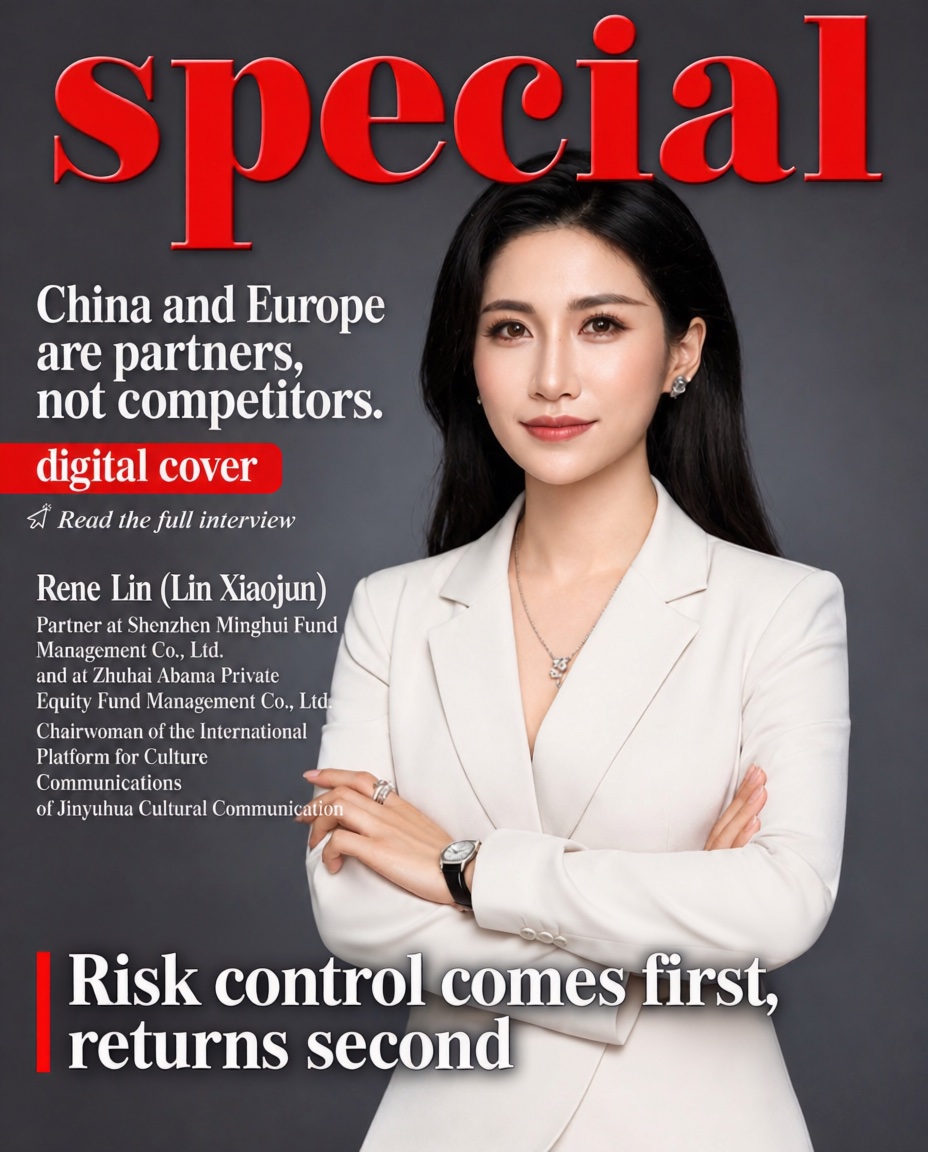
China and Europe are complementary partners, not competitors.

Rene Lin (Lin Xiaojun) is a new-generation international investor. She graduated with a
degree in Finance from the South China University of Technology (SCUT). This world-leading research institution is renowned for cultivating pioneering science and technology entrepreneurs and for its exceptional capacity in commercializing scientific research into industry.

Rene Lin is a partner at Shenzhen Minghui Fund Management Co., Ltd. and Zhuhai Abama Private Equity Fund Management Co., Ltd. She also heads Junyu Consulting, a premier cross-border industrial cooperation consultancy between China and Europe, and is the founder of Junyuhua Cultural Communication, an international cultural communications platform.
Through these endeavors, she has built a four-dimensional global business ecosystem encompassing frontier technology investments, multi-billion-dollar cross-border asset management, in-depth Sino-European industrial cooperation, and international cultural and people-to-people exchanges.

What brought you to the investment sector, and how did your long-term investment philosophy take shape?
– My journey into investing began with my academic background and the guidance of exceptional mentors. One of my professors was a partner at a global hedge fund, while another, a macroeconomics professor, served as a government advisor. During my studies, I had the privilege of interacting with Nobel laureates in economics. This early exposure showed me that investing is not merely a „numbers game“—it is deeply intertwined with the development of technological industries and global trends.
After graduating, I worked at key state-owned enterprises and hedge funds. Many of my colleagues and senior peers dedicated themselves to advancing Chinese industry and building bridges between China and the rest of the world. Their vision and dedication influenced me tremendously.
Throughout my development, I witnessed the rise and fall of many family-owned enterprises. I saw some traditional industrial families expand rapidly through short-term speculative capital activities, only to collapse later under the weight of economic cycles and industrial shifts due to the lack of a long-term strategy and a weak risk management system. I also saw businesses that stayed committed to the real economy and long-term value, successfully navigating multiple economic cycles. These observations shaped my
perspective on long-term investing: sound investments do not chase temporary market
noise; rather, it respects industrial cycles and historical rhythms, growing alongside eras, industries, and enterprises. This forms the foundation of my investment philosophy: industry as the anchor, cycles as the driving force, and a long-term orientation at the core.
Which qualities are most essential when building a career in the global investment sector?
– The global investment sector is a complex, multi-layered environment. Gender does not determine capability, but certain personal traits provide a solid foundation for practitioners in this field. First, integrity: being honest with the markets and our own judgments, respecting objective facts rather than succumbing to greed. Second, diligence: capital markets are constantly shifting and demand rigorous, in-depth research rather than over-reliance on past experience. Third, the ability to understand cycles and seize opportunities judiciously, avoiding reckless expansion or excessive hesitation. Fourth, an inherent sense of risk: returns are an outcome, but safety is the prerequisite. Fifth, an open mindset to embrace technological disruption and market transformations, avoiding rigid behavioral patterns.
How do you balance returns and risk control in cross-border asset allocation and family wealth management?
– My core principle is clear: risk control comes first, returns – second. In cross-border asset allocation, looking merely at paper returns is not enough. We must weigh macroeconomic conditions – such as political stability and currency stability in target jurisdictions – and show full respect for local cultural nuances and specific social contexts. We cannot mechanically transpose experience from one market into another.
In practice, asset optimization must be anchored in the family’s core business rather than blindly chasing trending sectors. I once advised a cross-border industrial family specializing in manufacturing. We steered clear of impulsive investments in highly volatile trendy assets. Leveraging their industrial strengths, we structured a multi-layered portfolio: low-risk European fixed-income instruments and prime overseas real estate as a stable foundation; cross-border tech equities and targeted new energy assets for long-term growth; along with highly liquid cash instruments to hedge against currency and geopolitical shocks, tailored to the needs of their cross-border operations. This multi-asset, diversified income architecture combined liquid reserves with resilient core holdings to mitigate cross-border volatility and secure cash flows, thereby driving sustainable long-term value appreciation.
Looking back through history, enduring family wealth has never been built solely on capital gains. Sustainable family businesses place great value on education, social responsibility, and philanthropy. Beyond preserving family succession, wealth carries an obligation to give back to society. Family wealth management is, in essence, long-term planning for intergenerational succession and social responsibility.
What is the significance of industrial cooperation between China and Europe in the new global economic landscape?
– China and Europe are complementary partners, not competitors. China possesses complete industrial ecosystems, massive consumer markets, and large-scale execution capabilities. Europe boasts solid foundational scientific research, sophisticated high-tech manufacturing, and maturity in green transition and social governance. Cooperation in new energy technologies between China and Europe is a prime example: Europe pioneered research into core photovoltaic materials and components, while China provides world-leading mass production, engineering deployment, and market refinement. These joint efforts have driven down costs and advanced technology across the global PV industry to mutual benefit. Sino-European cooperation can be described as civilizational inspiration and industrial complementarity. It brings invaluable certainty to a turbulent global economy and provides practical models for multipolar global governance.
What opportunities do you see for Bulgaria as a destination for tech investments and as a bridge between China, Europe, and international markets?
– Bulgaria possesses many unique, yet underrecognized advantages. Culturally, it shares with China a profound respect for family values and community ties. Geographically situated at the crossroads of the Balkans, Bulgaria serves as a natural Eurasian hub, offering competitive tax advantages within the EU and logistical access to both EU and Black Sea markets. The Bulgarian educational system produces exceptional talent in mathematics, software engineering, and algorithms. Labor costs are relatively lower than in Western Europe, creating a solid talent base for digital technologies and artificial intelligence.
As an EU member state, Bulgaria represents a strategic gateway for Chinese enterprises entering Europe. It is far more than a standalone investment destination: Bulgaria serves as a two-way bridge that channels European technology to East Asia while directing Chinese capital and industries through Central and Eastern Europe and broader global markets.
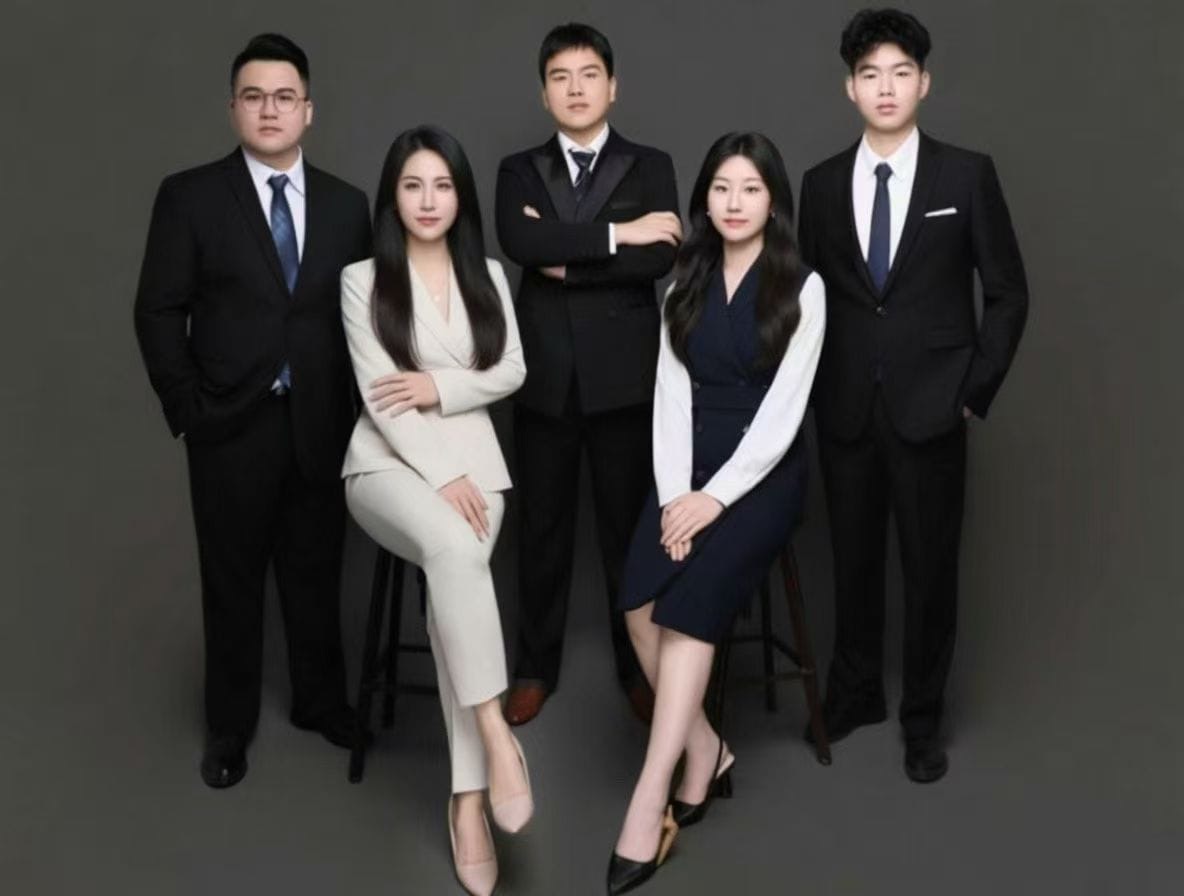
You describe capital as a link between global industries and culture as the foundation of international friendship. How does this philosophy translate into real-world projects?
– Capital provides the foundation for industrial flows, but culture determines whether cooperation will endure. We are actively working on Panda bond initiatives. Previously, we supported numerous real-economy entities from Central and Eastern Europe in accessing Chinese capital markets. Panda bonds provide cost-effective financing for their green industry and technology projects. This financial instrument embodies both the opening up of China’s financial system and the exchange between civilizations. Cross-border capital flows transfer not only funds, but also business norms and value systems.
Take a Bulgarian green agriculture project we supported: rather than a simple capital injection, we first examined local agricultural traditions, regulatory frameworks, and environmental standards before structuring a partnership aligned with Chinese market demands and capital advantages. My family has maintained long-standing friendly ties with Bulgaria, and that spirit infuses every project. As a Chinese saying goes, “First build friendship; then pursue cooperation and shared success.”