


















Eytan Shamir is the Director of the Begin-Sadat Center for Strategic Studies and an Associate Professor of Political Science at Bar-Ilan University. Previously, he served as the Head of the National Security Department at the Israeli Strategic Affairs Service.
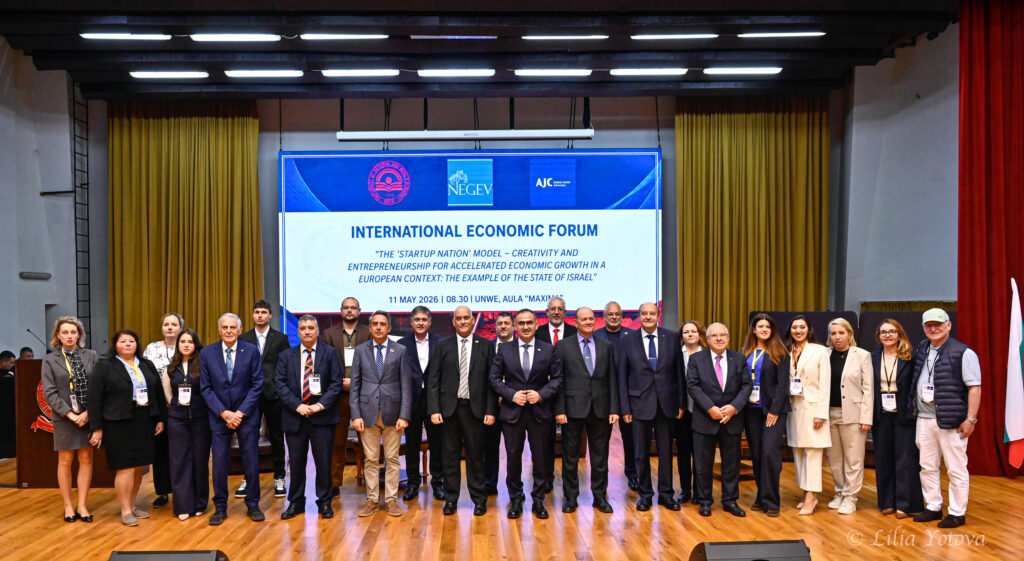
Professor Shamir was a special guest at the international economic forum: „The ‘Startup Nation’ Model – Creativity and Entrepreneurship for Accelerated Economic Growth in a European Context: The Example of the State of Israel.“
The unique forum was organized by UNWE at an exceptionally high level, thanks to Assoc. Prof. Dr. Nikolay Krushkov, Department of „Intellectual Property and Technology Transfer,“ and under the patronage of the Rector of UNWE, Prof. Dimitar Dimitrov.

Professor Shamir, welcome to Bulgaria. What is your first impression of our country?
– This is my first time in Bulgaria, and I hope to visit many more times in the future. I’ve only been here for two days, but I’ve already fallen in love with Sofia. The people are incredibly friendly and hospitable. Today, I had the opportunity to visit your National Museum and learn about your country’s ancient and interesting history. Given the very special relationship the Jewish community has in Bulgaria, we share a rich and fascinating history between our two countries and a promising future.
What can Bulgaria learn most quickly from the „Startup Nation“ Model applied in Israel?
– The success of the Startup Nation, or the „Startup Nation Model“, is due to a number of factors that allowed it to materialize. I would highlight technology education as particularly important, but also education in entrepreneurship and business.
Sometimes a technology has been available and in use for a long time. The innovation lies in how that technology can be used for a new service. Take Uber, for example – it’s an instance of existing technology that was then implemented in a specific, innovative way that completely transformed the industry.
There are also things the government can do to support startups.
We talked about the incubators we have in Israel – if you’re an entrepreneur, all the tools you need will be provided. If you have a good idea and prove its worth, you’ll be given a loan. If your project succeeds, you repay the loan. If it doesn’t succeed, you don’t have to repay the loan.
As mentioned at the conference, let me tell you about a serious problem that found an innovative solution: access to drinking water in Israel. Between 2000 and 2005, Israel faced a major water crisis due to an unprecedented drought. All sorts of ideas emerged to solve the problem. For instance, they considered bringing tankers, similar to those that transport oil, to deliver water from Turkey.
Then, Israeli scientists developed water desalination technology. Today, 70% of the water we drink in Israel is desalinated seawater. This comes with an economic cost. Therefore, scientists continued to develop the idea of how to reduce costs to make the technological process as efficient as possible.
The conclusion is that when you’re in a difficult situation, you’re forced to come up with practical solutions. There’s a famous story where Churchill, in the middle of World War II, gathered his cabinet and said, „Gentlemen, we’ve run out of money. Now we have to start thinking.“
When you study entrepreneurship and are hungry for development, you can find a solution to even the most complex problem.
I always tell the story of Michael Jordan. Even at the peak of his fame, he was the last player to stay long after every practice session to continue training, to perfect every shot. What does this show you? That this man was not only very talented. Talent alone is not enough.
Which Israeli innovation strategy do you think could most effectively transform Bulgaria’s economy?
– As I understand it, you have significant interests in information technology (IT) and the high-tech sector. Israel is a leader in cybersecurity, and this is one sector where we can successfully cooperate with Bulgaria.
All eyes are now on artificial intelligence (AI). In Israel, we are putting a lot of effort into being among the best in AI as well. In my opinion, this area will be the most important in the next few years. So, I think there is room for cooperation between Israel and Bulgaria in this regard. Of course, the security sector is also a focus and offers many opportunities for mutually beneficial partnership.
How important is national security for technological and economic growth today?
– This is a very good question because national security, economy, and technology go hand in hand. To develop as a nation, you need a strong economy in the long term. And to have national security, you must invest resources from that strong economy.
Many industries today are dual-use. They can be used for the security of the state, but at the same time, they are good for the market as a whole.
Many of the inventions we use today were developed for security purposes, for military purposes. GPS, for example, as well as the internet. The internet was developed by Americans for security reasons. It was used by the Pentagon as a secure communication network for the American military. Only after that was it introduced to universities by the academic community, and then adopted by businesses.
Every modern state needs national technological security. The use of technology from the military industry strengthens the economy, making it more robust.
What should Bulgarian universities change to encourage more entrepreneurship and innovation?
– In my opinion, universities should encourage independent thinking among students and should cooperate with industry. They should constantly create joint ventures and implement joint projects.
Both in high school and university, it is very important for every student to participate in an introductory course on entrepreneurship, to acquire strategic thinking, and at least basic financial literacy. The goal of education is to create leaders and entrepreneurs. I must tell you that some universities have not changed their curriculum in 100 years.
If you had to describe yourself in one word, what would it be?
– Personally, I am a very curious person. I always ask questions about the things around me. That’s… I suppose that’s why I’m a university professor today.